1. Initial assessment & placement
Language placement on entry, identification of needs and an individual interview.
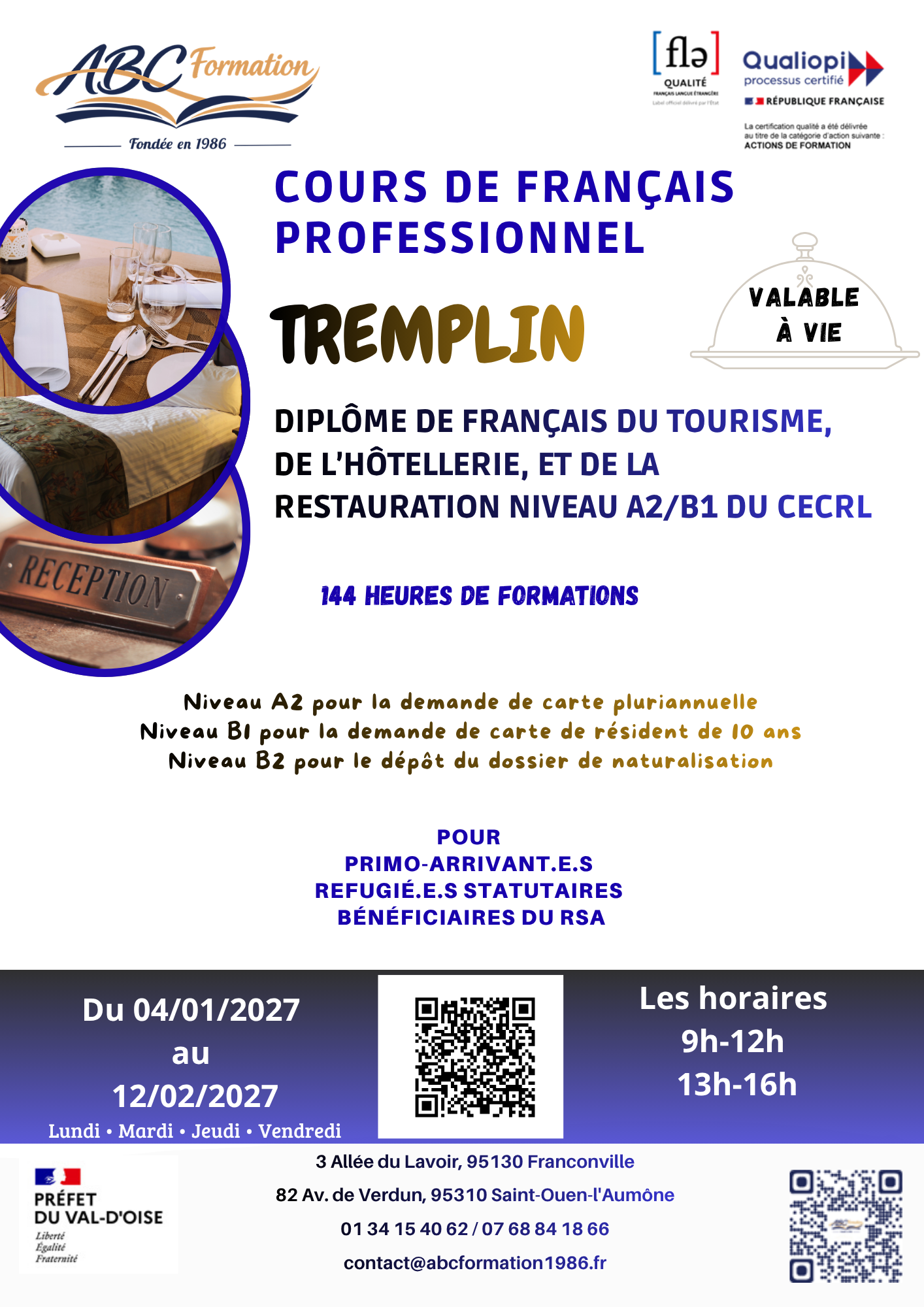
TREMPLIN – French for the Tourism, Hospitality and Catering (THR) trades
FLE training focused on professional integration — a sequence of achievements culminating in a recognised diploma and digital tool proficiency to promote the inclusion of newcomers.
The TREMPLIN programme supports newly arrived foreign nationals in developing their French skills and their professional integration in the tourism, hospitality and catering sectors. It combines general French, professional French (FOS), digital autonomy and socio-professional support.
Newly arrived foreign nationals eligible for the programme, in particular nationals of countries outside the European Union and beneficiaries of international protection (BIP), according to the applicable admission criteria. Particular attention may be paid to women, young people and people facing difficulties in finding employment.
To promote the lasting social and professional integration of beneficiaries by developing their language, digital and professional skills, in order to ease their access to employment or to qualifying training in the THR sector.
Skills certification improves employment access conditions and boosts integration into the professional environment.
A sequence of collective and individual actions to enable a sustainable return to employment or qualifying training.
Developing digital skills to facilitate social and professional inclusion in the host society.
Acquiring the maximum achievable language level based on the entry level, complementing the CIR — from below A1 up to the target B1 level.
A1, A2 or B1, determined by an initial placement.
A2, B1 or B2, depending on the individualised pathway, the objectives set and the beneficiary's progress.
The training combines general French courses, professional French activities, role-play situations linked to THR trades, digital workshops and support towards employment.
Teaching methods favour practical activities, role plays, authentic materials, interactive exercises and digital tools. Content is adapted to the learners' level and needs.
ABC Formation provides trainers specialised in French as a foreign language (FLE) and French for specific purposes (FOS), individualised teaching follow-up and, depending on the programme's arrangements, socio-professional support. Learners have access to teaching materials and computer equipment suited to the activities offered.
Language placement on entry, identification of needs and an individual interview.
Formative assessments, practical exercises and role-play situations to follow progress during the training.
At the end of the training, every learner must sit an official French certification, chosen according to their language level, skills and pathway. Two certifications are offered: the TEF (Test d’évaluation de français) and the DFP THR (Diplôme de français professionnel – Tourism, Hospitality and Catering), at levels A2, B1 or B2, depending on the learner’s level.
The choice of certification and level is made consistently with the initial placement, the learning progression and the objectives of the pathway. Sitting this certification is the final certifying assessment of the training and measures the learner’s language skills against the CEFR.
For each level, from A1 to C2, what a learner can do to understand, speak and write. The levels involved in this course are highlighted.
Understand familiar words and very basic phrases about myself, my family and my surroundings when people speak slowly and clearly.
Understand frequent expressions on topics close to me (family, shopping, work); catch the main point of short, clear messages and announcements.
Understand the main points of clear standard speech on familiar matters (work, school, leisure) and of many radio or TV programmes on current affairs.
Understand extended speech and lectures and follow complex arguments on familiar topics; understand most films in standard language.
Understand extended speech even when it is not clearly structured and relationships are only implied; follow television and films without much effort.
Have no difficulty understanding any spoken language, live or broadcast, even at fast native speed, given time to get used to an accent.
Understand familiar names, words and very simple sentences, for example on notices, posters and in catalogues.
Read very short, simple texts; find specific, predictable information in everyday material such as ads, menus, timetables and short letters.
Understand texts in everyday or job-related language; understand descriptions of events, feelings and wishes in personal letters.
Read articles and reports on contemporary issues where writers take a particular stance; understand contemporary literary prose.
Understand long, complex factual and literary texts and appreciate differences in style; specialised articles and long technical instructions.
Read with ease virtually every form of text, including abstract or complex ones (manuals, specialised articles, literary works).
Interact simply if the other person repeats or rephrases slowly; ask and answer simple questions on familiar topics.
Communicate in simple, routine tasks requiring a direct exchange of information on familiar topics; handle very short social exchanges.
Deal with most situations likely to arise while travelling; join in unprepared on familiar topics or topics of personal interest.
Interact with fluency and spontaneity with native speakers; take an active part in discussion, presenting and defending my views.
Express myself fluently and spontaneously without searching for words; use the language flexibly and effectively for social and professional purposes.
Take part effortlessly in any conversation, at ease with idiomatic expressions; convey finer shades of meaning precisely.
Use simple phrases to describe where I live and people I know.
Use a series of phrases to describe my family, living conditions, education and present or most recent job.
Link simple phrases to describe experiences, dreams, hopes and ambitions; briefly give reasons and explanations; tell a story.
Present clear, detailed descriptions on a wide range of subjects; explain a viewpoint, giving the pros and cons of different options.
Present clear, detailed descriptions of complex subjects, integrating sub-themes and rounding off with an appropriate conclusion.
Present a clear, smoothly flowing description or argument in a style suited to the context, with a logical structure that helps the audience notice key points.
Write a short, simple postcard; fill in forms with personal details (name, nationality, address).
Write short, simple notes and messages, and a very simple personal letter, for example to thank someone.
Write simple connected text on familiar topics; write personal letters describing experiences and impressions.
Write clear, detailed text on many subjects; write an essay or report passing on information or giving reasons; write letters highlighting what matters to me.
Express myself in clear, well-structured text; write about complex subjects in letters, essays or reports, underlining key points; adapt style to the reader.
Write clear, smooth, stylistically appropriate text; write complex letters, reports or articles; summarise and review professional or literary works.
Access to the programme is subject to checking eligibility criteria, an interview and an initial placement. Dates, duration and organisational arrangements are communicated to applicants according to the sessions offered.
ABC Formation looks into the adaptation needs of people with disabilities in order to facilitate their access to the training and their participation.
For any information about the TREMPLIN programme, access arrangements or registration conditions, contact ABC Formation through its website.
Lundi · Mardi · Jeudi · Vendredi
144 heures
Scan the QR code to view the scheduleThe programme is contracted and funded by the State. The training is open to participants who meet the eligibility conditions defined for the programme, subject to validation of their admission.
ABC Formation is committed to promoting access to training for people with disabilities.
Specific needs can be reported from the placement interview onwards so that the educational, technical or organisational adjustments needed for the course to run smoothly can be considered.
Disability officer: Hanan Lahmidi.
Each request is examined individually to identify possible adjustments to teaching methods, materials and reception conditions, according to the learner’s needs and the resources available.
For any adaptation need, please contact our disability officer directly:
Mme LAHMIDI Hanan
Disability officer